


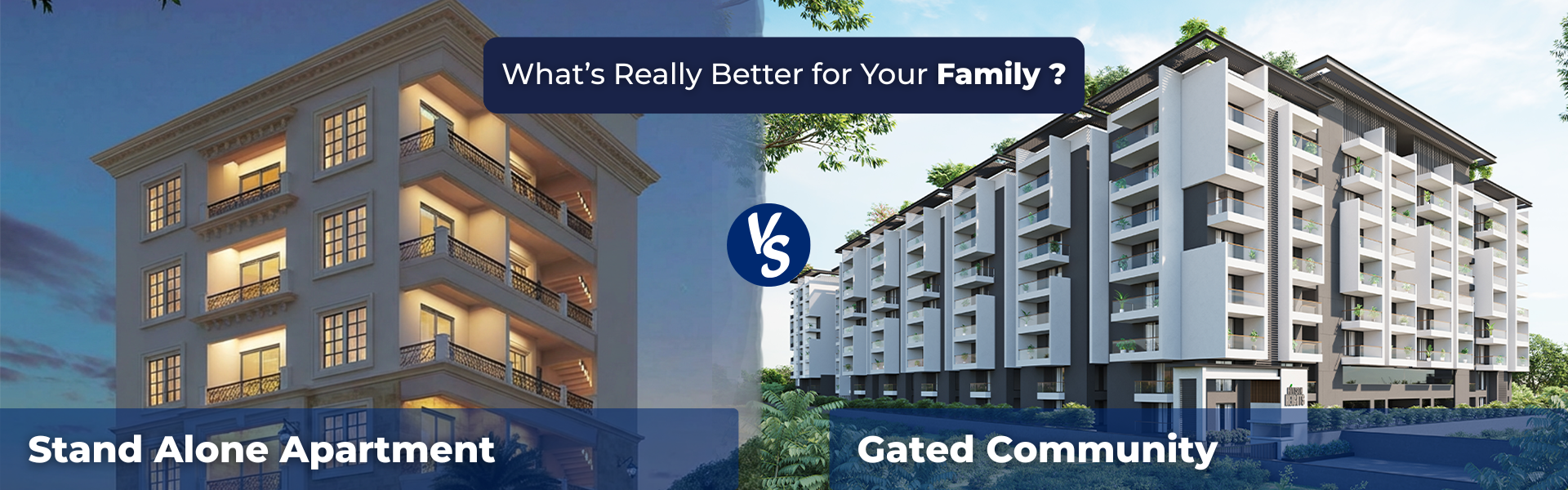
Standalone vs Gated Community Apartments: What’s Really Better for Your Family?
When you buy a home, you’re not just buying walls and a ceiling—you’re choosing a lifestyle for your children, your parents, and yourself. You’re also deciding how secure you’ll feel, how strong your social circle will be, and how fast your property will grow in value.
In most Indian cities today, the real dilemma is this: standalone apartment vs gated community apartment—especially when you think about kids’ safety, senior citizens’ comfort, social life, transparency, and long-term returns.
This article breaks down the reality in a professional, practical, and slightly hard-hitting way—so you can see through the “sales talk” and choose what truly works for your family.
Big Picture: How These Two Models Really Differ
A standalone apartment is typically a single building on a small plot, usually built by a local builder, often with limited or no amenities and basic or informal security.
A gated community apartment is part of a larger, planned project with multiple blocks, controlled entry and exit, professional maintenance, amenities like clubhouse, play areas, parks, and usually stronger compliance with regulations and safety norms.
In simple terms: standalone apartments often feel cheaper and more flexible; gated communities feel safer, more organised, and more future-ready—especially for children and senior citizens.
Children: Safety, Play, and Everyday Freedom
For families with small children, this is usually the make-or-break factor.
In gated communities, children benefit from:
- Controlled entry and exit, with security guards and CCTV, so unknown people can’t walk in easily.
- Dedicated kids’ play areas, internal roads with low-speed traffic, and more “eyes on the street”, which together create a safer outdoor environment.
Many Indian developers highlight that gated communities are now the preferred choice for families precisely because they combine play, safety, and social interaction in one ecosystem.
In standalone apartments, children often:
- Play on the street outside, where traffic, strangers, and lack of supervision are real concerns.
- Have fewer kids of similar age in the same building, which limits their social circle and group learning.
If your top priority is everyday free play without constant fear, gated communities clearly have an upper hand.
Senior Citizens: Comfort, Care, and Peace of Mind
Senior citizens need more than just a house—they need safety, accessibility, medical support, and company.
Gated communities increasingly cater to seniors by offering:
- Round-the-clock security, CCTV, and access control, which reduces fear of theft, trespassing, or harassment.
- Internal walking tracks, gardens, benches, and common spaces that encourage routine walks and social interaction.
- Faster access to emergency help—neighbours, security staff, and in some projects even tie-ups with nearby hospitals or on-call medical support.
Studies and market reports show that senior citizens living in well-designed gated communities tend to maintain more active, socially engaged lifestyles with better support networks.
In standalone apartments, seniors may:
- Face inconsistent or weak security, especially when there are no guards and open entries.
- Have fewer neighbours around during the day and limited community events, increasing feelings of isolation.
For ageing parents or planning your own later years, a gated community generally provides a more structured, predictable, and safer environment.
Social Life: Isolation vs Community Ecosystem
Your home also shapes your social capital—who you meet, how often you interact, and how strong your support system becomes.
In gated communities, you typically see:
- Festivals, sports events, community gatherings, and cultural programs organised by resident associations.
- Children making friends quickly, seniors joining groups, and young professionals networking through in-society clubs and events.
Real estate experts note that this “intangible” sense of community is a major reason many Indian families now actively prefer gated living.
In standalone apartments, social life is often:
- Limited to a few neighbours, with fewer organised events or shared spaces to naturally meet others.
- Dependent on individual initiative rather than a built-in community structure.
If you want your children to grow up in a neighbourhood where they can participate in society-level activities—and your parents to have regular company—gated communities are usually more socially rewarding.
Transparency, Monopoly, and Governance: Who Really Controls Things?
Here is where the “monopoly” and “transparency” angle kicks in, especially for standalone apartments.
In many standalone projects:
- The builder often retains disproportionate control over key decisions (maintenance contracts, parking allocation, structural changes), at least until an active association is formed—sometimes much longer.
- Documentation, approvals, and long-term obligations are often less transparent to buyers, especially in smaller, locally executed projects.
This can create a monopoly-like environment, where one party (the builder or owner) effectively controls pricing of maintenance, repair decisions, and even usage of certain common areas without enough checks and balances.
In gated communities:
- Larger developers usually follow stricter regulatory frameworks, with documented processes, RERA registrations, and organised handovers to Resident Welfare Associations (RWAs).
- Once the association is active, decisions on maintenance, upgrades, and rules are taken collectively, which increases transparency and accountability.
This doesn’t mean gated communities are problem-free—but the governance model is more structured, and owners have more voice in the long term.
Security: Real-World Risks for Kids and Daily Life
Security is often the first practical difference you feel after moving in.
Gated communities typically offer:
- Security guards at all entry and exit points.
- CCTV in common areas and sometimes within lifts and parking.
- Visitor tracking and access control (tokens, intercom, apps, or pass systems).
Data and industry reports show that such measures lead to lower crime rates and higher perceived safety, especially for families with children.
Standalone apartments usually:
- Rely on minimal or informal measures—one watchman or none, no systematic visitor tracking, and often no CCTV.
- Allow easier access for vendors, delivery people, and unknown visitors without much verification.
For small children, this difference is critical: in a gated community, they can often move around within the campus more freely; in standalone buildings, parents usually need to supervise closely or limit outdoor time.
Lifestyle and Everyday Convenience: Real-Time Problems You’ll Actually Face
Beyond theory, your day-to-day life is where the contrast becomes sharply visible.
In gated communities, daily living often feels more streamlined because of:
- In-house amenities like supermarket, pharmacy, gym, salon, or crèche, reducing dependency on external trips.
- Professional facility management for water supply, power backup, cleaning of common areas, and waste management.
Many large projects now position themselves as “integrated townships” precisely because they bundle lifestyle, convenience, and safety together.
In standalone apartments, real-time problems generally include:
- Irregular water supply, limited or shared borewells, and ad-hoc tanker dependency, managed by a small group of owners.
- Lift breakdowns or building repairs where cost-sharing becomes contentious due to fewer paying members.
Standalones can feel simpler initially, but over time, maintenance burdens and coordination challenges can escalate, especially as the building ages.
Economics: Upfront Cost, Monthly Burn, and Hidden Expenses
Financially, many buyers are drawn to standalone apartments because they appear cheaper at first glance.
Standalone apartments typically:
- Offer lower per-square-foot prices compared to branded gated communities in the same micro-market.
- Have relatively lower monthly maintenance—but with fewer services and often no amenities.
However, hidden or long-term cost can arise from:
- Repeated repairs, painting, lift replacement, and structural fixes shared among a small number of owners.
- Security upgrades (CCTV, more guards) that suddenly increase monthly outgo if the association decides to level up.
Gated communities usually:
- Cost more to buy because of better planning, amenities, and brand premium.
- Have higher—and predictable—maintenance charges that cover security, amenities, landscaping, and common infrastructure.
For many families, the question becomes: Do you want to pay slightly more every month in a structured way—or face unpredictable, sharp expenses in a standalone as problems arise?
Property Value and Future Appreciation: Where Does Your Money Grow Faster?
From an investment and wealth-creation standpoint, property value appreciation is a serious factor.
Recent trends in Indian cities show that:
- Gated community apartments consistently outperform standalone buildings in terms of resale and rental values, due to stronger demand, better security, and superior amenities.
- Buyers increasingly associate gated communities with trust, quality construction, and reliable upkeep, which supports higher long-term valuations.
Experts highlight that gated projects in cities like Hyderabad, Bengaluru, and Mumbai are now commanding higher ROI, with more stable rental yields and faster absorption in resale.
Standalone apartments can still appreciate, especially if they are in prime locations, but they often lack the brand pull, amenity stack, and perception of safety that drive premium pricing.
If you are viewing your home as both a place to live and a long-term asset, gated communities usually offer a stronger growth trajectory.
Key Differences at a Glance
| Aspect | Gated Community Apartment | Standalone Apartment |
|---|---|---|
| Children’s safety | High security, controlled entry, internal play areas | Limited security; children often play on public roads |
| Seniors’ comfort | Walkways, benches, social groups, better emergency support | Limited common areas; more isolation |
| Social life | Events, festivals, clubs, strong community bonding | Low-scale interactions, few shared activities |
| Transparency & control | Structured governance via RWAs; clearer processes | Builder-led decisions initially; limited resident control |
| Security | 24/7 guards, CCTV, visitor management | Minimal or informal security; open access |
| Lifestyle convenience | Amenities and services within the campus | Basic living; dependence on external facilities |
| Upfront cost | Higher purchase price | Lower purchase price |
| Maintenance | Higher but structured; includes amenities | Lower monthly cost; occasional large expenses |
| Property value growth | Stronger appreciation; higher resale and rental demand | Moderate appreciation; limited premium |
Challenges in Standalone Apartments: Monopoly, Risk, and Limited Ecosystem
While standalone apartments can work well for some, they come with structural challenges, especially when viewed through the lens of families and seniors.
Core issues often include:
- Monopoly-like control where one builder or a small group dictates terms on maintenance, parking, and usage of common spaces—especially in the early years.
- Lack of formal systems for dispute resolution, leading to frequent conflicts between owners and builders or among owners themselves.
For families with young children and elderly parents, this unpredictability can make the living environment feel unstable—socially, operationally, and financially.
Challenges in Gated Communities: Rules, Costs, and Over-Regulation
Gated communities are not perfect either; they simply shift the nature of problems.
Typical challenges include:
- Higher maintenance fees, which can feel heavy if your income is variable or if you don’t use many of the amenities.
- rules and regulations defined by the association—about pets, noise, parking, renovations, short-term rentals—that may feel restrictive at times.
Some seniors may also initially feel socially overwhelmed or culturally mismatched if the community is very large and diverse, though many adapt and ultimately appreciate the support network.
So the real question for you is: Are you comfortable trading slightly higher cost and more rules for more safety, transparency, and social structure?
How to Decide: Aligning Choice with Your Family’s Reality
When you cut through the marketing, your decision should rest on a few core filters:
Ask yourself:
- Do you have young children or plan to? If yes, gated communities usually offer a better environment for safe play and social growth.
- Are you caring for senior citizens—or planning for your own retirement? Then a secure, amenity-rich gated community can significantly improve quality of life.
- Is maximum short-term affordability your only priority, and are you okay with limited amenities and more uncertainty? Then a standalone apartment might be workable, especially in a superb location.
- Are you thinking long-term about resale, rental income, and asset appreciation? Then gated community apartments are generally the more future-proof investment.
For most urban, family-oriented buyers in India today, the balance tilts strongly towards gated community living—particularly when factored across children’s security, seniors’ comfort, transparency of governance, and growth in property value.
Frequently Asked Questions
1. What is the key difference between standalone apartments and gated community apartments?
The primary difference lies in planning and governance. Standalone apartments operate as individual buildings with limited shared amenities and informal management, whereas gated community apartments are master-planned developments with controlled access, professional facility management, transparent governance, and integrated lifestyle amenities.
2. Why are gated community apartments considered safer for children?
Gated communities are designed with child safety as a core priority. Features such as controlled entry and exit points, 24/7 security personnel, CCTV surveillance, vehicle-free internal roads, and dedicated play areas allow children to move and play freely within a secure environment.
3. Are gated community apartments suitable for senior citizens?
Yes. Gated community apartments typically include senior-friendly infrastructure such as elevators in every block, ramps, walking tracks, seating areas, proper lighting, and access to emergency support. The social environment also helps seniors stay active, engaged, and independent.
4. Do standalone apartments lack transparency in management?
In many cases, standalone apartments rely on informal or self-managed systems, which can lead to decision concentration among a few individuals and limited financial visibility. Gated communities follow structured governance models with elected committees, documented bylaws, and transparent accounting practices.
5. How does social life differ between standalone apartments and gated communities?
Standalone apartments often have smaller resident populations, limiting social interaction. Gated communities foster vibrant social ecosystems through shared amenities, festivals, clubs, fitness activities, and community events, creating a stronger sense of belonging for residents of all age groups.
6. Are maintenance costs higher in gated community apartments?
Gated community apartments generally have higher maintenance charges due to security, amenities, and professional management. However, these costs contribute to better infrastructure, consistent upkeep, and long-term property value, making them cost-effective over time.
7. Which option offers better property value appreciation?
Gated community apartments typically show stronger long-term appreciation due to planned development, lifestyle appeal, higher demand, and better resale liquidity. Standalone apartments rely mainly on location-based growth and may face limited demand during resale.